Sagility is a global leader in technology-led healthcare operations, built on a simple conviction: that when people grow, organisations do too. With nearly 50,000 professionals across five countries, Sagility has made the growth journey of its employees as central to its mission as the outcomes it delivers for clients. Careers here are not managed — they are co-created.
A company built on healthcare’s hardest problems.
Sagility’s business is structured around three core pillars: deep domain expertise, technology-led transformation, and trusted collaboration. Mohit Saxena, Global Chief Delivery Officer, explains what that means in practice: “We are an organisation focused solely on the US healthcare industry. We are solving client issues — not doing checklist management. The way we build deep domain is through the knowledge of the industry, the use of technology to showcase the solutions we have built, and by collaborating not just across our internal departments but with the larger healthcare ecosystem.”
That philosophy — solving problems end-to-end rather than owning a narrow slice of a process — shapes not just how Sagility delivers to clients, but how it builds its people. When the work is interconnected, the people have to be too.
Boomerang employees are often treated as an HR curiosity. At Sagility, they are something more concrete: a signal that the culture being described from the inside is real enough to be missed from the outside. And in a company where Sep has spent 24 years, where employees move across functions and geographies, and where the work itself carries the weight of patient impact — the conditions for that signal to fire are not incidental. They are built.
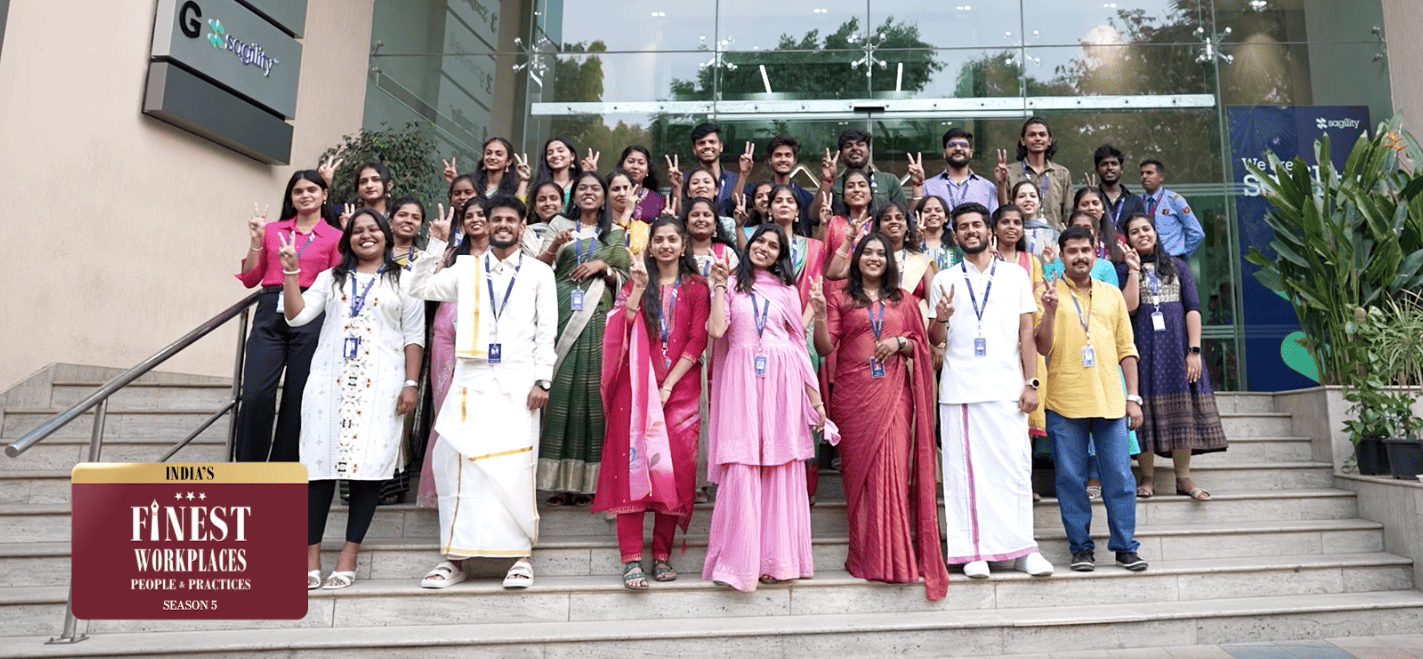
Fig. 01
Sagility India — home to a workforce of 18,000+ across six delivery locations, and one of India’s Finest Workplaces 2026–27.
Culture as a lived experience, not a statement.
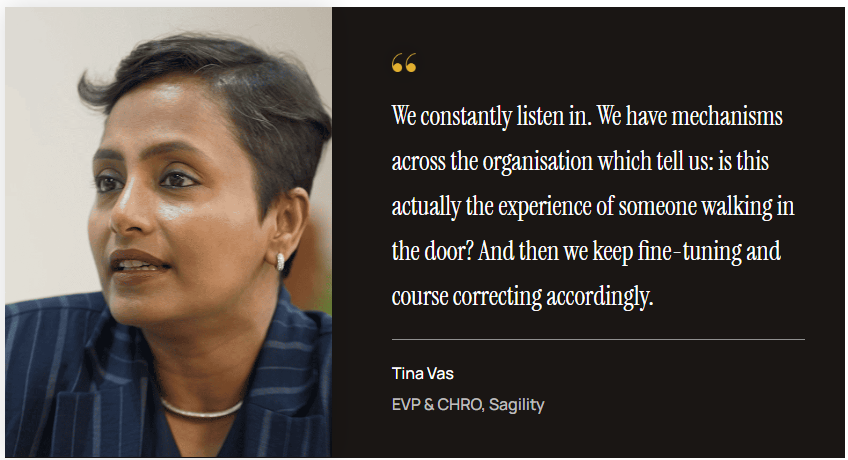
Tina Vas, EVP and CHRO at Sagility, leads the people and culture function for a workforce of 48,000-plus employees spread across five countries and multiple generations — from Gen X professionals who have been with the company for decades to Gen Z associates joining today. The challenge she describes is one that large organisations rarely solve cleanly: ensuring that the values the company espouses at the top are the same values an employee encounters on day one, in a remote delivery centre, far from headquarters.
Achieving that requires three things running in parallel: identifying the cultural levers that must hold firm across every geography and generation; ensuring that leaders at every level are active agents of those values, not just adherents to them; and maintaining a continuous listening infrastructure that catches the gap between aspiration and reality before it widens.
The career path that lived experience, not a statement.
Growth as architecture
Sagility builds careers structurally, not opportunistically. Employees move not just upward but laterally: across functions, geographies, and account types. Trainer to quality lead. Quality lead to operations manager. Operations to transition specialist. India to international delivery. The organisation co-creates the arc with the individual, rather than waiting for a vacancy to prompt a conversation.
Mohit Saxena describes the organisational logic: “What we do is upskill employees, build on their domain, and ensure that they move not just within one function but across. That is what has helped us scale the global leadership team.” For a business that delivers end-to-end healthcare services, deep domain cannot live in a single function. It has to travel across the organisation. The internal mobility structure is therefore not an HR benefit — it is how Sagility builds the capability it needs to serve clients well.
For employees, the effect is tangible. “This gives you a sense of belongingness,” says Sep. “You are part of the company’s growth. You are part of the success story.”
Learning celebrated. Mistakes welcome.
In healthcare operations, the cost of a knowledge gap is not abstract — it shows up in a patient’s care pathway, in the accuracy of a clinical review, in the outcome of a payer’s adjudication decision. This gives learning at Sagility a weight it doesn’t carry in most industries. Tina Vas is explicit about the philosophy: “Learning in our organisation is celebrated, and mistakes are just treated as opportunities to correct yourself.”
The approach is structured across three dimensions. First, role capability building — ensuring that each employee has a deep understanding of the healthcare domain relevant to their function, not just the transactional skills of their immediate role. Second, coaching and shadowing — learning embedded in real work, not separated from it. Third, active opportunities to display new skills — so that growth is visible, recognised, and connected directly to the next career step.
The same philosophy extends to Sagility’s approach to technology and transformation. As Saxena describes it, the guiding framework is simple: why does a task need to exist? Can it be eliminated? Can it be automated? For tasks that still require people, how do we optimise the output? The result is a workforce that does not just execute processes — it questions them, and is encouraged to do so.